De redactie van NRC selecteert de beste artikelen uit The Economist voor een breder perspectief op internationale politiek en economie. Ukraine’s war is now longer than the first world war The ghost of Versailles haunts Ukraine’s peace. Dit artikel komt uit The Economist :format(webp)/s3/static.nrc.nl/wp-content/uploads/2026/06/12131115/140626OPI_2034421476_WEB_ILLU_Economist_Ukraines-War_Javi-Aznarez.jpg) On June 11th Europe passed a sombre milestone.
As of that date, the fighting in Ukraine had ground on for longer than the first world war. In a grim irony, a conflict that looked like it might last just a few days, as Russian troops confidently stormed towards Kyiv in February 2022, has outlasted one some assumed would be „over by Christmas” in 1914.
Whether in this century or last, war has defied the best-laid plans of military high commands. Soldiers were promised triumphant parades in conquered capitals, but soon found themselves bogged down, often literally. Conscripts defending their homelands huddled in foxholes, their trenches turned to quagmire.
Novel weapons—tanks, machineguns and mustard gas back then, drones today—reshaped warfare. Men died, families grieved. Maps were updated as towns and villages, or rather what was left of them, changed hands. Alas, a long war is no guarantee of a just peace—as the Treaty of Versailles, signed in 1919, went on to show.
But the echoes of that failed armistice might usefully inform efforts to bring hostilities in Ukraine to a close. The „war to end all wars” is remembered these days as a prequel to the even grislier conflict it helped midwife a generation later. The ghost of Versailles should thus haunt those valiantly trying to end the current conflict.
Ukraine’s allies have helped it not lose the war. Soon they will have to gear up to help it win the peace. De redactie van NRC selecteert de beste artikelen uit The Economist voor een breder perspectief op internationale politiek en economie. For now, serious talks remain elusive.
Surely, after 1,568 days of near-uninterrupted fighting, the end of this war should be nearer than its beginning. The recent tentative turning of the tide in Ukraine’s favour may nudge Russia towards the negotiating table. Territorial gains the aggressor made at enormous cost—around 1,000 Russian men dead or seriously wounded every day, say the Ukrainians—are now being partly reversed.
Ukrainian drones are reaching deep inside Russia, each plume of putrid smoke a humbling message to President Vladimir Putin. Europe is about to start disbursing a €90bn ($104bn) loan to Ukraine, helping its ally even as help from America has dried up. Ukrainian troop morale is at a recent high.
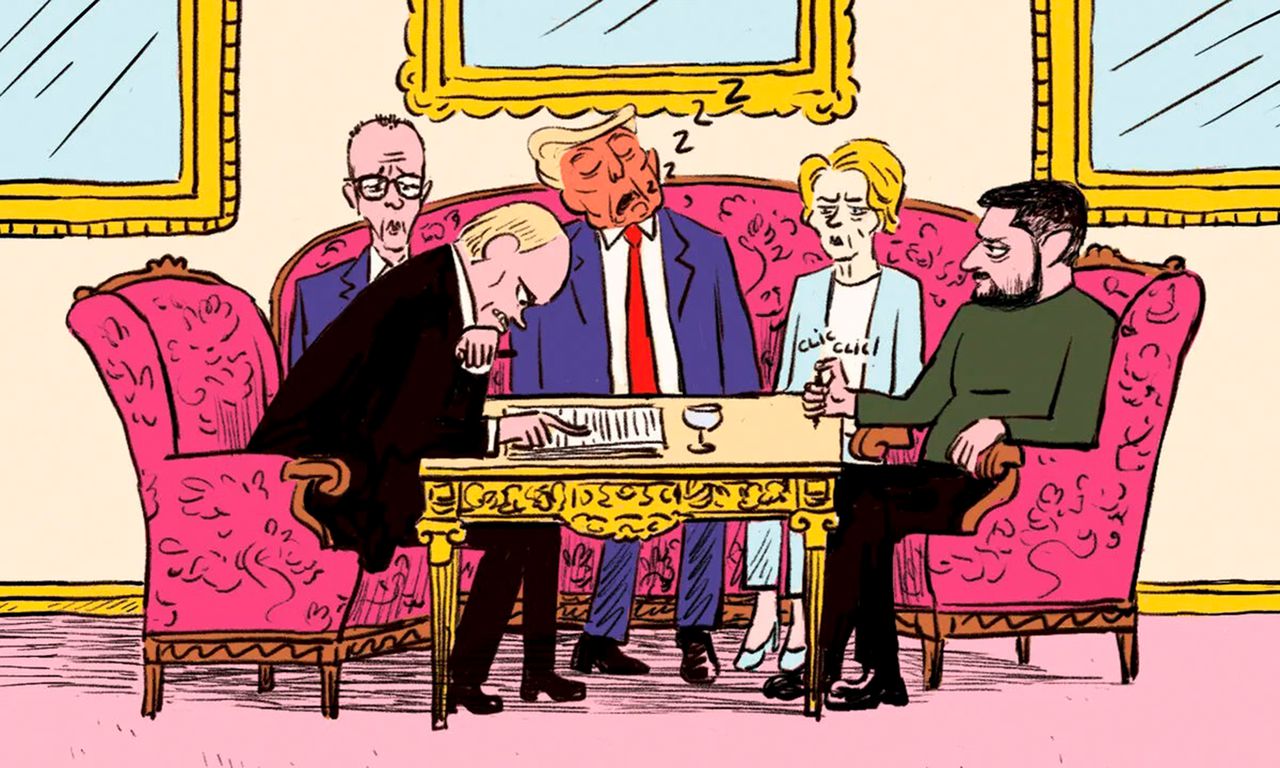
President Volodymyr Zelensky, once a haggard, hollow shell of a man, can occasionally be seen smiling these days. But his challenges to Mr Putin to engage in peace talks—backed on June 7th by the leaders of Britain, France and Germany—have come to nothing thus far.
Mr Putin says nyet. When an armistice in this conflict comes, it will differ in flavour from that signed in the Hall of Mirrors in 1919. Russia will not be a broken, defeated country with no choice but to accept intemperate diktats from its adversaries. Notwithstanding the demands of Ukraine’s most strident allies—not least those in the Baltics or Poland, who worry unchecked Russian revanchism might target them next—there will be no war reparations paid, nor rulers rendered to international courts.
Peace will be a messy, unsatisfying affair full of compromises that neither side will want to live with. And yet they will have to, if the drones are to be silenced. But there will be parallels with Versailles, too. Both the peace in 1919 and the forthcoming one in Ukraine will be sealed as part of a new security architecture in Europe.
Back then it was a hobbling of Germany, financially and militarily, as well as a new-fangled League of Nations to defuse wars before they could get started. This time a new European order will include security guarantees to Ukraine that will have to be backed by a „coalition of the willing” in Europe, one tacitly willing to fight Russia.
There is talk of a European Security Council, though few details. Ukraine’s bid to join the European Union will reshape both its fortunes and those of the bloc. And what of America’s role? Woodrow Wilson spent six months in Europe trying to seal the peace, only the second sitting president to leave America.
His successor, Donald Trump, once promised to end the fighting in Ukraine „within 24 hours”, but has since started a new war instead. What are the lessons of Versailles? One is that promises made to secure peace need enforcement mechanisms. In the wake of the peace in 1919, America ultimately balked at joining the League, its Senate fretting about foreign entanglements.
One mechanism to constrain Russia’s future designs on Ukraine will be credible security guarantees—underpinned in fine by Ukraine joining the EU. On June 15th the bloc’s 27 member states will unanimously agree to open the first negotiating cluster, another step towards Ukraine’s accession.
But the odds of that happening soon—or perhaps at all—are longer than Kyiv’s friends care to admit. If Ukraine feels it has been promised a brighter future as an EU member and that somehow fails to materialise, its people may end up embittered, like the Germans of 1933.
If the EU is not, in fact, ready to welcome Ukraine, it should come clean now. The guns of August, the drones of June The contours of a peace agreement are still too distant to divine. Ukraine seems ready to accept losses of territory—an inevitable outcome at this stage.
Europe, which is stuck between being a mediator for talks or a party to them, will be among those with impossible choices to make. To secure peace it may end up lifting sanctions on Russia, and perhaps even sending back hundreds of billions of euros it froze and once hoped to send to Ukraine instead.
There will be talk of normalising diplomatic relations. That will be denounced in some quarters as little short of treason. A crude interpretation of Versailles is that humiliating the aggressor leads to resentment and thus sows the seeds of further war. A better lesson is that the longing for retribution cannot be an end in itself.
The desire to see Mr Putin humbled or worse will be justifiably strong in Europe. His abhorrent regime is guilty of the worst crimes; the war is his responsibility. And yet one day, hopefully soon, he may be a partner in making peace. Subscribers to The Economist can sign up to our Opinion newsletter, which brings together the best of our leaders, columns, guest essays and reader correspondence. © 2026 The Economist Newspaper Limited.
All rights reserved. The Economist Lees meer Mail de redactie Ziet u een taalfout of een feitelijke onjuistheid? U kunt ons met dit formulier daarover informeren, dat stellen wij zeer op prijs. Berichten over andere zaken dan taalfouten of feitelijke onjuistheden worden niet gelezen.
Artikel delen De link is nog geldig. Je hebt al eerder van dit artikel een cadeaulink aangemaakt, de link is nog geldig. Leuk dat je onze journalistiek deelt met anderen. Vanaf kun je weer artikelen cadeau geven. Deel dit artikel via sociale media. Hoe werkt het delen van artikelen?
Als cadeau Als NRC-abonnee kun je elke maand artikelen cadeau geven aan een willekeurige ontvanger. Standaard delen Kies je voor standaard delen, dan kan iedereen met een NRC-abonnement de door jou gedeelde artikelen lezen. Niet-abonnees krijgen een betaalmuur te zien.
Je bent nog niet ingelogd NRC Mijn NRC Contact NRC-websites